Apr 15, 2026
Vitamin D deficiency is the most common nutritional condition in the UAE. It affects an estimated 75 to 80 percent of adults across the Gulf region — including people who live in one of the world's sunniest countries. The irony is not lost on anyone. But the science behind it is straightforward, and once you understand it, the solution becomes simple too.
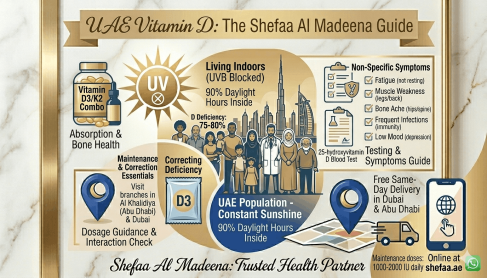
Your body makes Vitamin D when skin is exposed to UVB sunlight. In theory, the UAE should have no deficiency problem at all. In practice, the opposite is true. Most UAE residents spend 90 percent of daylight hours indoors — in offices, homes, and cars — to avoid the extreme heat. When they do go outside, they are often covered or wearing sunscreen that blocks UVB rays. The result is a population living in constant sunshine but barely producing any Vitamin D.
Diet fills the gap only partially. Fatty fish, egg yolks, and fortified dairy contain Vitamin D, but rarely in the quantities needed to maintain adequate blood levels. Without supplementation, deficiency is almost inevitable for most UAE residents.
The tricky thing about Vitamin D deficiency is that its symptoms are non-specific. They could be caused by dozens of different things, which is why many people live with the deficiency for months or years without realising it. The most common signs include persistent fatigue that does not improve with rest, muscle weakness particularly in the legs and lower back, bone ache especially in the hips and lower spine, frequent infections — because Vitamin D plays a key role in immune function — and low mood or depression.
In children, severe Vitamin D deficiency causes rickets — softening of the bones. In adults, long-term deficiency is linked to osteoporosis, increased fracture risk, and growing evidence suggests links to cardiovascular disease and certain cancers.
A 25-hydroxyvitamin D blood test is the standard measure. You need a prescription from a UAE doctor to get this test done at a private or government lab. Most clinics in Dubai and Abu Dhabi offer this as part of a general health check panel. Optimal blood levels are considered to be 40 to 60 ng/mL. Levels below 20 ng/mL indicate deficiency. Levels between 20 and 30 ng/mL are considered insufficient.
If your level comes back low, your doctor will recommend supplementation dosage. However, many people opt to start supplementation without testing first — particularly if they have clear symptoms and know their lifestyle does not include adequate sun exposure.
For maintenance in UAE adults, 1000 to 2000 IU of Vitamin D3 daily is a reasonable starting point. If your test shows deficiency, a doctor will often prescribe a higher loading dose — sometimes 5000 IU daily for 8 to 12 weeks, then a maintenance dose. Self-prescribing above 4000 IU daily without testing is not recommended, as Vitamin D toxicity — though rare — can cause calcium imbalance.
The form matters. Vitamin D3 (cholecalciferol) is better absorbed than D2 (ergocalciferol). Combining D3 with Vitamin K2 improves calcium metabolism and directs it to bones rather than arteries — making D3/K2 combination supplements a better choice than D3 alone for most adults.
Vitamin D3 and D3/K2 combination supplements are available at all Shefaa Al Madeena branches and through shefaa.ae online with free delivery across Dubai and Abu Dhabi. The pharmacy team can advise on dosage, brand quality, and whether your current medications have any interactions with Vitamin D supplementation — particularly if you are on blood thinners or calcium-containing medications.
Visit shefaa.ae or call +971-54-279-7001 to order. Same-day delivery available for orders placed before 3 PM.